A bit of history today...
NEXUS Marketing B2B Lab®
The Altair 8800, created in 1975 by the American company MITS (Micro Instrumentation and Telemetry Systems), is considered to be the first personal computer. However, the Programma 101, developed by Olivetti in Italy in 1965, was the first successfully marketed personal computer, featuring a compact design and a simple user interface. Although the Programma 101 is not considered a true "PC" because it was not user-programmable, it laid the foundation for the personal computers that followed.
This story shows us how capable the European industry was of producing revolutionary innovations, yet it fell victim to the lack of vision of certain corporate leaders. The Programma 101 was an extraordinary achievement for its time, but it was underestimated by investors who preferred to sell the patents rather than develop them. It is important to recount this history so we do not forget the true inventors of the personal computer and to encourage the European industry to continue innovating and believing in its own capabilities.
Here is thefull storyby Andrea Longhi in Italian.
And a courtesy translation below:
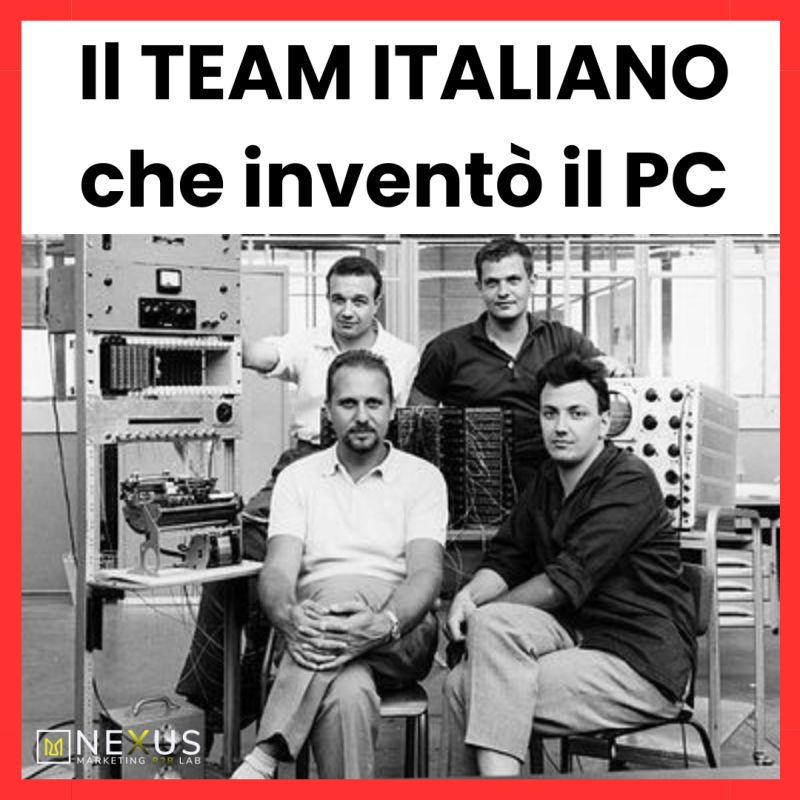
"No, this isn't about Wozniak or Steve Jobs, but the REAL inventors of the personal computer; this is an Italian story that changed the world.
Ivrea, 1962: the visionary genius Adriano Olivetti has already passed away, and the company's management has been entrusted to his son, Roberto.
However, an engineer named Pier Giorgio Perotto has a brilliant idea, worthy of the great Adriano: to build a data processing machine that offers functional autonomy, is small enough to fit on any desk, and is programmable, equipped with memory, flexible, and easy to use.
Perotto creates a team of young engineers: Giovanni De Sandre, Gastone Garziera, and Giancarlo Toppi. They work on this "IMPOSSIBLE" project for the time, considering that until then, computers were the size of rooms and could only be used by expert programmers.
One year after the project launch, the team manages to develop a first rudimentary prototype renamed the "Perottina." Unfortunately, however, Olivetti sinks into a deep financial crisis. New partners arrive and, failing to understand the enormous potential of the company's electronics department, sell it to the American company General Electric along with all the patents, following the motto...
"No European company can enter the electronics market; it's not for us, we aren't up to the task—that's what the Americans are for."
Perotto, however, manages to exempt himself and his team from the transfer and continues to work on his visionary project, having the machine's design created by Mario Bellini (a famous designer of the time).
1965, New York. The final prototype of the Programma 101 is finally ready, and it is presented to the general public at BEMA (the Business Equipment Manufacturers Association show), the largest trade show of the era.
The FIRST PC was an incredible success. This time, it was judged not by corporate executives (who understood little about electronics), but by ordinary people. Everyone wondered where the cable was that connected this beautiful machine to a "real computer"; no one could believe that this was the computer itself.
The cost dropped from the 100,000 dollars of the time for a traditional computer to just over 3,200 dollars. Everyone wanted one; even NASA bought several units.
Unfortunately, at Olivetti, apart from Perotto's small group, there were no longer the electronic technicians and engineers needed to design further product developments or to organize a sales network capable of selling a product so different from typewriters or calculators.
Olivetti tried to bring back the technicians and engineers who had ended up at OGE (General Electric), where they were working for the Americans, but the process was slow, while the American industry, having grasped the importance of the innovations introduced by the P101, wasted no time in following the same path.
The rest is history...